

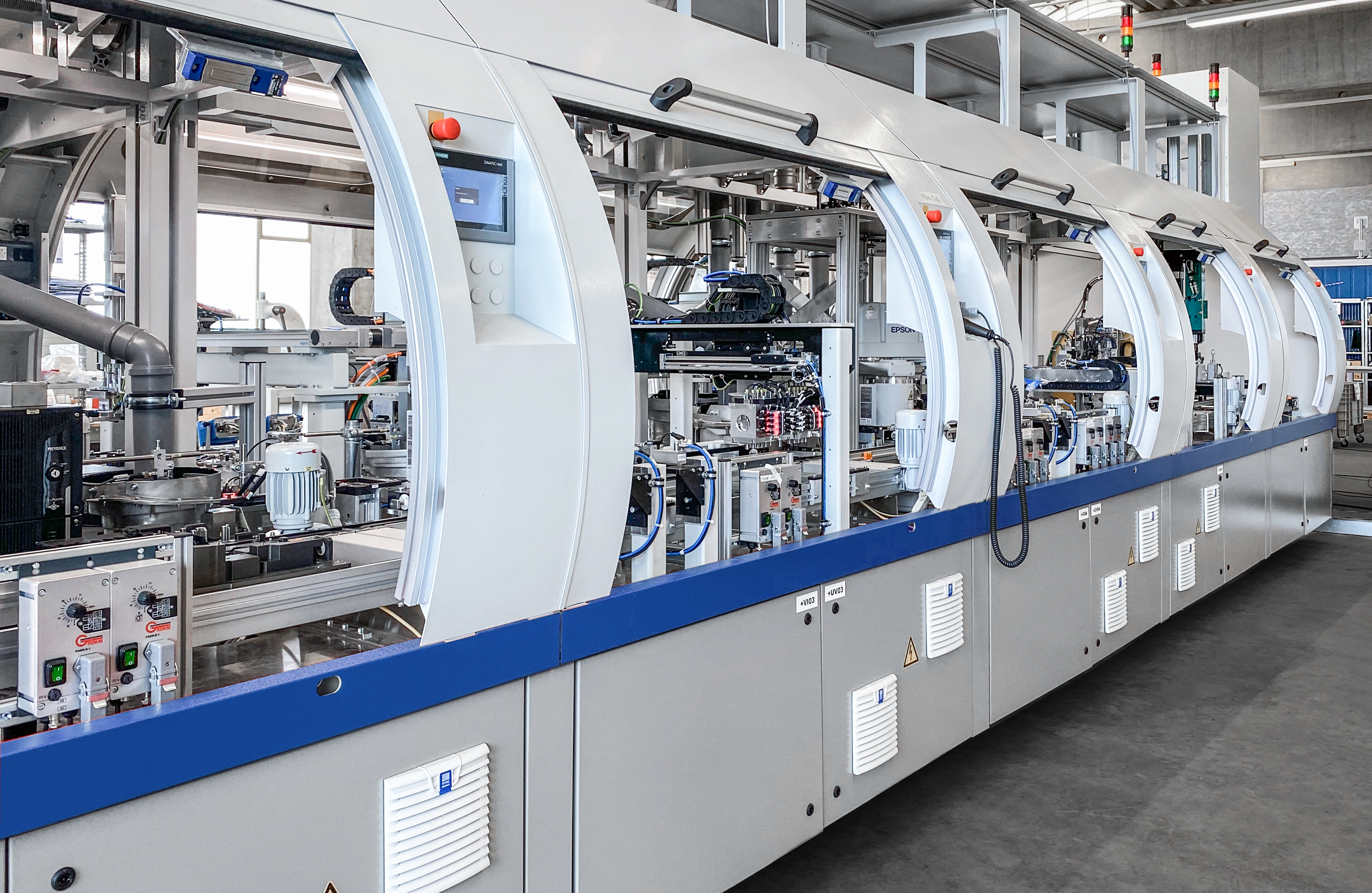
There are numerous concepts for assembling vehicle components, each with varying degrees of automation. Many processes are still carried out manually, and the step towards automation often presents a significant hurdle for companies.
We want to fully support our customers during the transition and accompany them on their journey from manual assembly to automated manufacturing of their products.
Component design, assembly sequence and tolerance concepts – the basic requirements for functioning automation
The design of the component is the central aspect when considering the potential automation of assembly processes. For example, gripping areas must be defined to guarantee the integrity of the components. Furthermore, the component design should ensure a logical assembly sequence. Costly components should be integrated as late as possible, if possible, to minimize potential scrap costs in the event of defects.
Another crucial point is the provision of individual parts. While pins, for example, can easily be provided as bulk material and processed by the worker during manual assembly, providing them as bulk material is not so straightforward for automated assembly. Singulation and feeding via vibrating bowls could damage the pins – delivery in trays and processing via tray destacking systems or feeding via Anyfeeder systems would be a viable solution here. We contribute our experience right from the concept development stage and provide our customers with recommendations in the area of parts logistics.
Different principles apply to the design of tolerance concepts in automation. In manual assembly, it is easier for the operator to compensate for any tolerances. In automated assembly, fixed screw points are always used, for example. If necessary, additional camera systems can be employed to adjust the screw point relatively flexibly. However, the simpler and, above all, more cost-effective solution is to minimize tolerances through appropriate component design. This should be considered as early as the component development stage, if possible.
Development of various concept proposals and economic feasibility studies as a basis for decision-making
Finding the right balance between manual labor and investment in automation technology can often seem daunting at first glance. Especially when transitioning from manual assembly to automation, we prioritize providing our customers with a highly transparent breakdown. To this end, we develop several system concepts with varying levels of automation, which our customers can use as a basis for their profitability calculations. We create a variant matrix that considers the product ramp-up curve – including potential manual labor, automation level, space requirements, necessary order deadlines, and investment costs in the system technology.
If necessary, systems are initially planned with a higher proportion of manual workers, based on the production volume curves, and then gradually automated. This approach is not only particularly economical, but also gives the customer the opportunity to gradually familiarize themselves with the automation process.
Prerequisites for plant commissioning and the creation of the infrastructure for automated production
It is not only the question of the right concept that is crucial; we determine the parts requirements for commissioning in advance and work with our customers to develop sound acceptance concepts for the system.
Furthermore, we provide our customers with the necessary information for relocating the equipment and integrating it into their production facilities. This includes, for example, the design of transport routes, the correct unloading equipment, and advice on preparing the complete on-site infrastructure – such as specifications regarding interfaces to pneumatics and electricity, or advice on designing the data management system.
Intensive training and reliable service support make it easier to get started with automation
We understand that getting started with automation represents a major change and can potentially present a challenge. To alleviate any concerns our customers may have, we focus on a very intensive training concept, developed jointly with them, especially for initial automation projects.
A detailed introduction of the personnel in the areas of mechanics, electrical engineering, and maintenance ensures a comprehensive understanding of the system. The programmers receive in-depth training in PLC programming, robotics, and image processing.
Furthermore, we offer a comprehensive service package, particularly during the initial setup phase of the system, to reliably support our customers. This also includes ensuring the service availability of subcontractors, such as screwdriver or robot manufacturers.
Your partner for the shared path to automation
Our goal is to provide our customers with comprehensive support and guidance for their first automation projects: from component design and choosing the right system concept to commissioning and operation of the system, including reliable training and service support – with AKE technologies as your experienced and reliable partner, getting started with automation is guaranteed!

 +49 851 95584-0
 info@ake-technologies.de
 Adolf-Hoellinger-Straße 3, D-94034 Passau-Patriching