

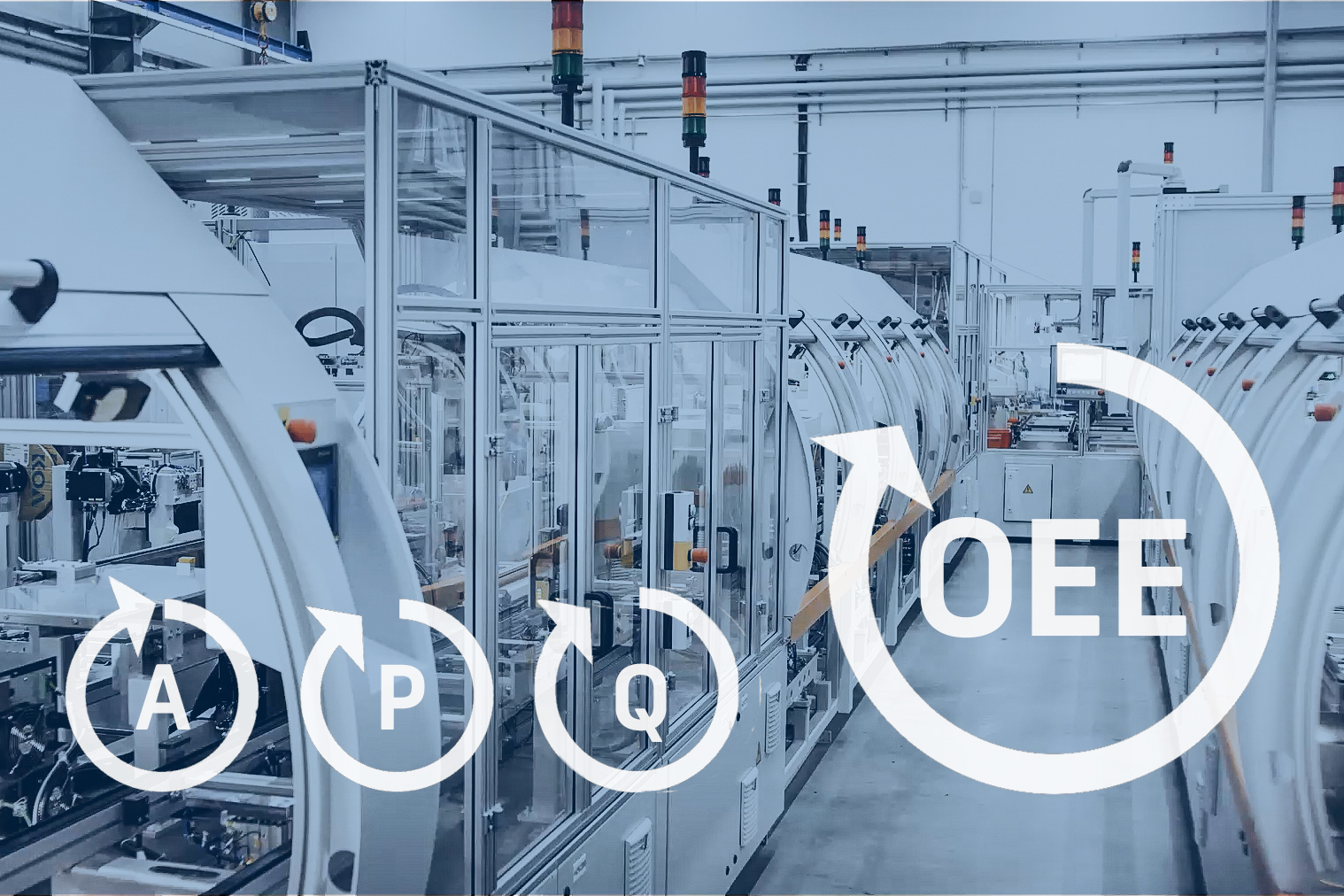
a is Overall Equipment Effectiveness (equipmentOEE account) overallcomplex key performance indicator for manufacturing companies and represents the effectivenessthe most frequent and significant sources of productivity losses in manufacturing. Intelligent plant concepts can also increase the planned total production time of a plant. The automation experts at AKE technologies rely on flexible plant designs to minimize setup times. Depending on the application, intelligent, variant-independent grippers and handling systems are installed that automatically adjust their gripping position to the respective component variant. To save time, necessary gripper changes on robot systems are automated. Manual setup processes are simplified as much as possible, for example, using the setup cart principle. To make the best possible use of the resulting total production time, our engineers must always keep the overall equipment effectiveness (OEE) in focus during the development of our production plants, which now refers to the actual plant output within the available total production time.
The OEE value is composed of the following three factors:
- Availability
- Performance
- Quality
Optimizing Overall Equipment Effectiveness

Around the Plant availability To increase reliability, we ensure fail-safe solutions when integrating all individual components and install quickly replaceable wear parts. Redundant material feeds guarantee that the process can continue even if a single system fails, thus ensuring uninterrupted production. An intelligent layout of the maintenance area optimizes accessibility, ensuring rapid troubleshooting. To prevent unplanned downtime altogether, AKE technologies' service technicians utilize Maintenance 4.0. An analytics tool independently monitors the condition of the entire system, the individual processes, and the installed components. Problem reports and recommended actions are automatically forwarded to the operator.
The next aspect to consider in plant planning is.. Plant output This requires avoiding micro-disruptions, parts shortages, and rigid system linkages. Operator workstations are evaluated not only for ergonomics – reach and walking distances are minimized, and insertion processes are designed efficiently. We ensure the decoupling of operator activities by avoiding direct insertion into cycle-driven systems. Intelligent logistics are also a priority within the automated production process. Buffer systems or parallel stations are used at critical bottlenecks to prevent unnecessary delays. Intelligent cycle time design in pre-assembly and upstream testing processes also generates a buffer for subsequent processing steps. This minimizes the impact of defective components on the overall system process. Furthermore, AKE's automation experts develop contingency plans that ensure redundant design of process-relevant components.
Finally, the "OK" parts produced by a system are crucial. Quality losses arise from factors such as component tolerances or tool wear. To ensure the Quality To increase the quality of the produced components, camera-based joining processes are used to compensate for component tolerances. Furthermore, the integrated production processes automatically adapt to current conditions, such as torque tests. Integrated dummy tests and tool checks for the independent monitoring of measuring systems complete the solutions for improving component quality.
OEE metrics allow us to analyze plant areas, identify problem areas, and develop optimization strategies to increase productivity. For us as automation experts, OEE is therefore a crucial tool for improving our processes Plant engineering to continuously develop further.
Are you looking for an automation expert for your production?
Feel free to contact us!

 +49 851 95584-0
 info@ake-technologies.de
 Adolf-Hoellinger-Straße 3, D-94034 Passau-Patriching